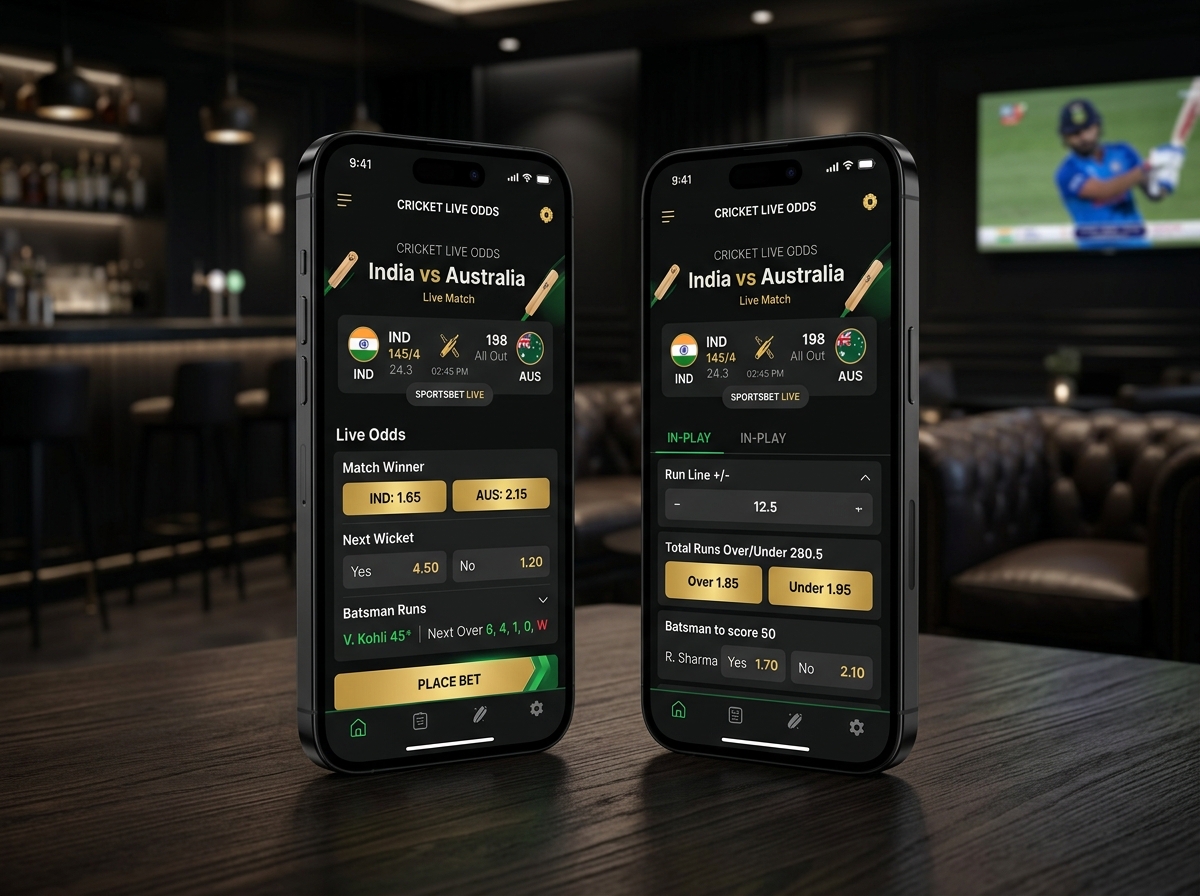
The Fundamental Shift: Player-vs-Bookmaker vs Peer-to-Peer
For decades, sports wagering followed a single traditional format: the fixed-odds bookmaker. In this legacy model, a centralized bookmaker determines the prices, takes the opposite side of every bet, and builds a mathematical profit margin (the "overround" or "juice") into every quote.
The invention of the Betting Exchange revolutionized sports markets by introducing a peer-to-peer marketplace. On an exchange, individuals bet against other individuals rather than against a company. The exchange operator simply provides the technology platform to match buyers and sellers, charging a small commission on net winnings.
Backing vs Laying: The Blue and Pink Interface
When opening an exchange match screen for an IPL or international cricket encounter, the odds display is split into two color-coded columns: Back (typically Blue) and Lay (typically Pink).
| Action | Interface Color | What It Means | Your Role | Financial Outcome |
|---|---|---|---|---|
| BACK | Blue Box | You believe an outcome WILL occur (e.g., India will win) | Traditional bettor | Win if the selection wins; risk only your initial stake amount. |
| LAY | Pink Box | You believe an outcome WILL NOT occur (e.g., India will lose) | Acting as the bookmaker | Win the backer's stake if selection loses; liable for the backer's profit if selection wins. |
Understanding Lay Liability: The Critical Calculation
When you "Back" a team with ₹1,000 at odds of 2.50, your maximum risk is simply your ₹1,000 stake, with a potential profit of ₹1,500. However, when you Lay a team, your financial exposure reverses:
If you Lay Team A for a stake of ₹1,000 at odds of 2.50:
- Your potential profit is the backer's stake: ₹1,000
- Your potential loss (Liability) is:
Stake × (Odds - 1) = ₹1,000 × (2.50 - 1) = ₹1,500
The exchange software automatically reserves this ₹1,500 liability from your account balance as security before accepting the lay order.
Why Exchanges Generally Offer Superior Value
- Closer to True Market Odds: Because thousands of independent participants compete to match orders, exchange spreads are tight. A traditional bookmaker might offer India at 1.80 and Australia at 1.90 (a 10% built-in margin). On an exchange, you might see India Back 1.95 / Lay 1.96, reflecting real market consensus.
- The Power to Cash Out and Hedge: In fluctuating cricket matches, odds move constantly after every boundary or wicket. An exchange allows you to "back high and lay low" (or vice versa), securing a guaranteed green profit regardless of which team ultimately wins.
- No Unfair Account Restrictions: Traditional bookmakers frequently restrict or ban users who display consistent profitability. Exchanges, by contrast, welcome winning participants because they earn revenue from commission on net profits.
Common Beginner Mistakes on Cricket Exchanges
- Confusing Unmatched with Cancelled Orders: If your requested odds are higher than current market availability, your order remains Unmatched in the queue until another participant accepts your price. Always review your active bet list.
- Overlooking Commission Deductions: Platforms typically levy a 2% to 4% commission on net market profits. Factor this into your calculated returns.
- Ignoring In-Play Execution Delay: During live matches, exchanges impose a mandatory 4-to-7 second broadcast delay on order submission to prevent courtsiding (exploiting stadium feed advantages).
Frequently Asked Questions (FAQ)
What does 'Laying' a team mean on a cricket exchange?
Laying a team means you are betting against them. If you lay Mumbai Indians, you win if Mumbai Indians lose or tie the match. You act as the bookmaker to someone else who wants to back Mumbai Indians.
What happens if my exchange order remains 'Unmatched'?
If no counterparty accepts your proposed price, the order remains unmatched. You can cancel unmatched orders at any time for an immediate refund of your reserved funds. Any orders still unmatched at the end of the match are automatically voided and refunded.
What is 'Bookmaking' or 'Cash Out' on an exchange?
Cash Out (or hedging) involves placing an opposing back or lay bet after match odds have shifted in your favor, locking in an equal profit across all possible outcomes before the final ball is bowled.
How does the exchange operator make money if players bet against each other?
The exchange charges a nominal commission (usually between 2% and 4%) solely on net winning bets in a given market. If you lose a bet, the exchange charges zero commission.